
 Book a Strategy Call

The short answer
To rank in Perplexity, your page first has to contain the words people use in their question, because Perplexity’s first pass is a word-matching search. Then put those words where they count: in your title and headings, with key phrases kept together. Write one clear paragraph that fully answers the question on its own. Finally, build trust through links and mentions from other sites. Perplexity checks its most “useful” pages first, and rewriting your page won’t change that.
That’s the whole post in one paragraph. The rest explains why, and how to do it without becoming an SEO nerd.
What Perplexity actually told us
On September 24, 2026, Perplexity’s engineering team published a long post about Photon, the new in-house engine that finds and ranks pages before its AI writes an answer. Most of the coverage focused on speed. Perplexity reports its slowest searches (p99) dropped from about 800 milliseconds to about 65.
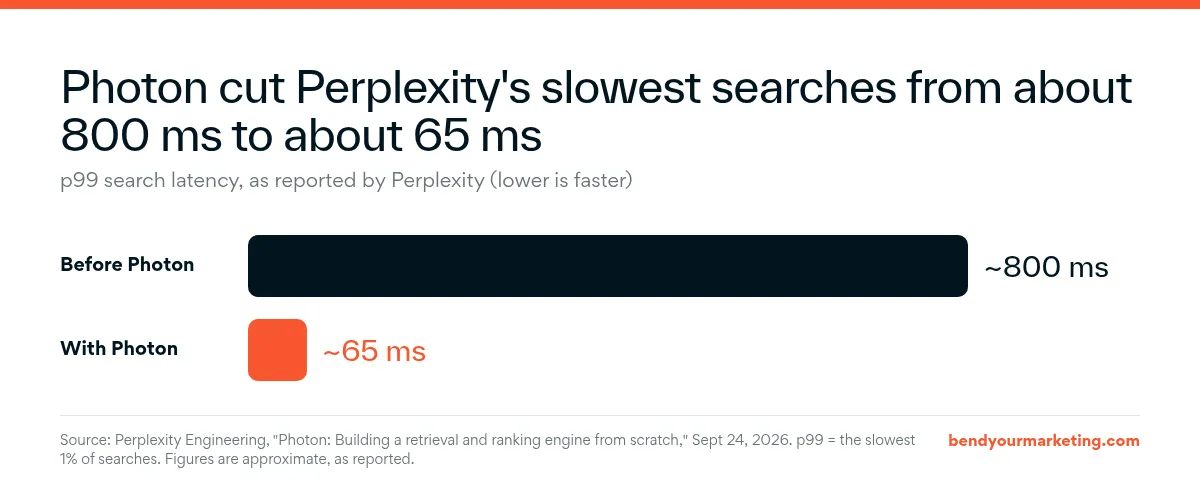
That’s interesting if you build search engines. What caught my attention was something else. To explain how Photon got fast, Perplexity described how it picks pages. It’s rare for an AI company to say this much about it in public.
Here’s my takeaway: Perplexity’s first step looks a lot more like old-school search than AI magic. If you’ve done good, honest SEO, you’re closer than you think. If you’ve been told AI search needs a whole new bag of tricks, it mostly doesn’t.
Six things that decide whether Perplexity sees your page
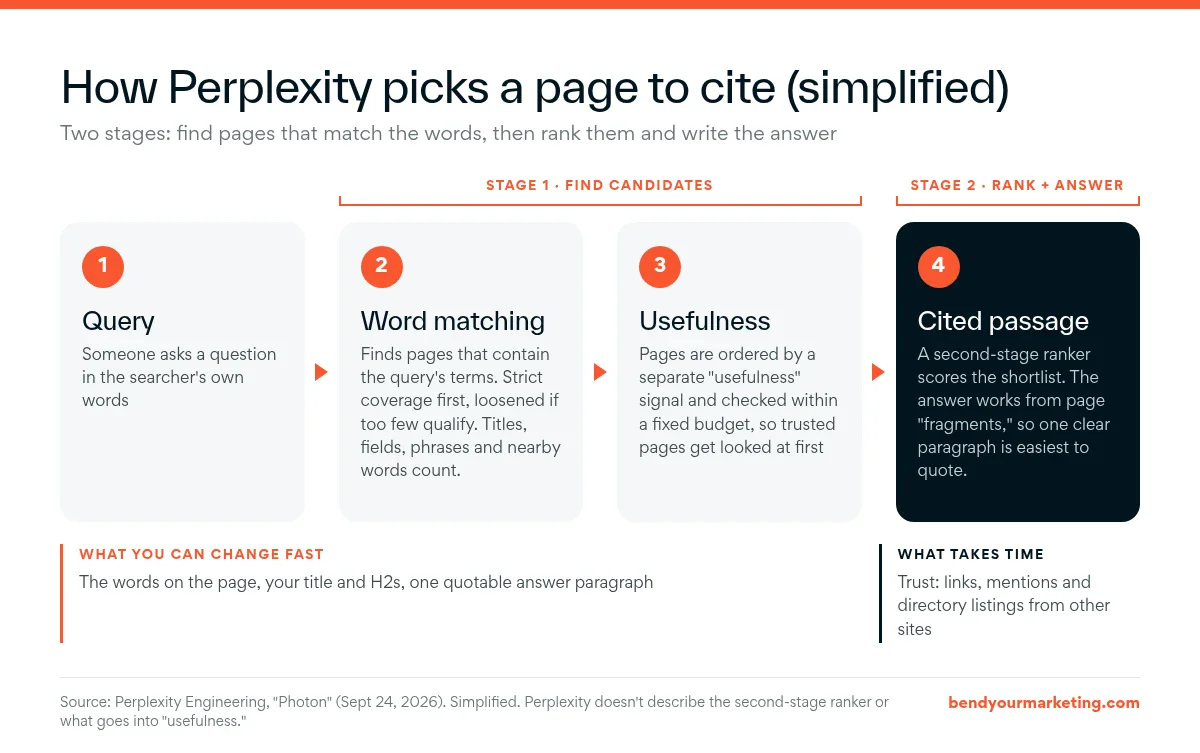
1. Your page has to use the words in the question
Perplexity’s post says its “lexical retrieval starts with query terms and finds documents that contain them.” In plain English: Photon looks for pages that contain the words in the search. It starts strict, wanting pages that cover the question’s terms, and loosens up only if too few pages qualify.
Perplexity doesn’t name its scoring formula. But what it describes (credit for covering the query’s terms, adjusted for page length, with a cap on repeats) works a lot like BM25, the classic formula search engines have used for decades.
What this means for you: if the question is “how do I become Catholic as an adult” and your page only ever says “Join us on the journey,” you may never make the shortlist. Write the way people actually ask.
Perplexity doesn’t say how it rewrites or expands a question. But AI answers usually cover the follow-up questions too (How long does it take? What does it cost? Who do I call?). Answering them on the page is cheap insurance.
2. Repeating your keyword stops helping fast
Photon caps the gains from repeated terms and normalizes for document length. So saying “Catholic school in South Bend” fifteen times doesn’t beat saying it a few times, and a long page doesn’t win just for being long.
What this means for you: covering a missing subtopic beats repeating your main keyword. One sentence about tuition assistance is worth more than a third mention of “Catholic school.”
3. Titles and headings count separately
According to the post, “each field runs its own pass, and the results are merged using field weights.” Photon also stores which fields each word appeared in. Perplexity doesn’t list the fields. My bet is the page title and headings are among them, because that’s how search engines have always worked.
What this means for you: a title and H2s that match the question do work that body copy can’t. “Becoming Catholic: OCIA at St. Example Parish” beats “Faith Formation.”
4. Exact phrases and nearby words matter
Photon stores where each word appears on the page. Its ranking step uses “the locations and proximity of occurrences.” That’s search-engine speak for: words that sit close together, and exact phrases, can count for more.
What this means for you: use the phrase people search, intact. “Marriage prep classes” in one sentence is stronger than “marriage” in one paragraph and “classes” three paragraphs later.
5. A “usefulness” signal decides who gets looked at first
This one surprised people. Inside Photon’s index, pages are “ordered by a separate usefulness signal so that more promising candidates are encountered earlier.” And Photon works within a fixed budget for each search, so it doesn’t look at every page.
Perplexity doesn’t say what goes into usefulness. My educated guess is the usual trust signals: links, mentions on other sites, and how well-known your organization is as a real entity. But that’s a guess.
What this means for you: two pages with the same words won’t be treated the same. No rewrite fixes a trust problem. That takes partners linking to you, local press, directory listings, and time.
6. Write one paragraph worth quoting
Perplexity says it prepares “fragments” of each page along with the text when it builds its index. The post doesn’t explain how those fragments are scored or used. My read, and the way AI answers behave in practice, is that the answer model works from pieces of your page, not the whole thing.
What this means for you: one tight, complete answer paragraph can beat a longer, “deeper” page whose answer is spread over ten paragraphs. That’s why this post opens with one.
Three reasons a good page gets skipped
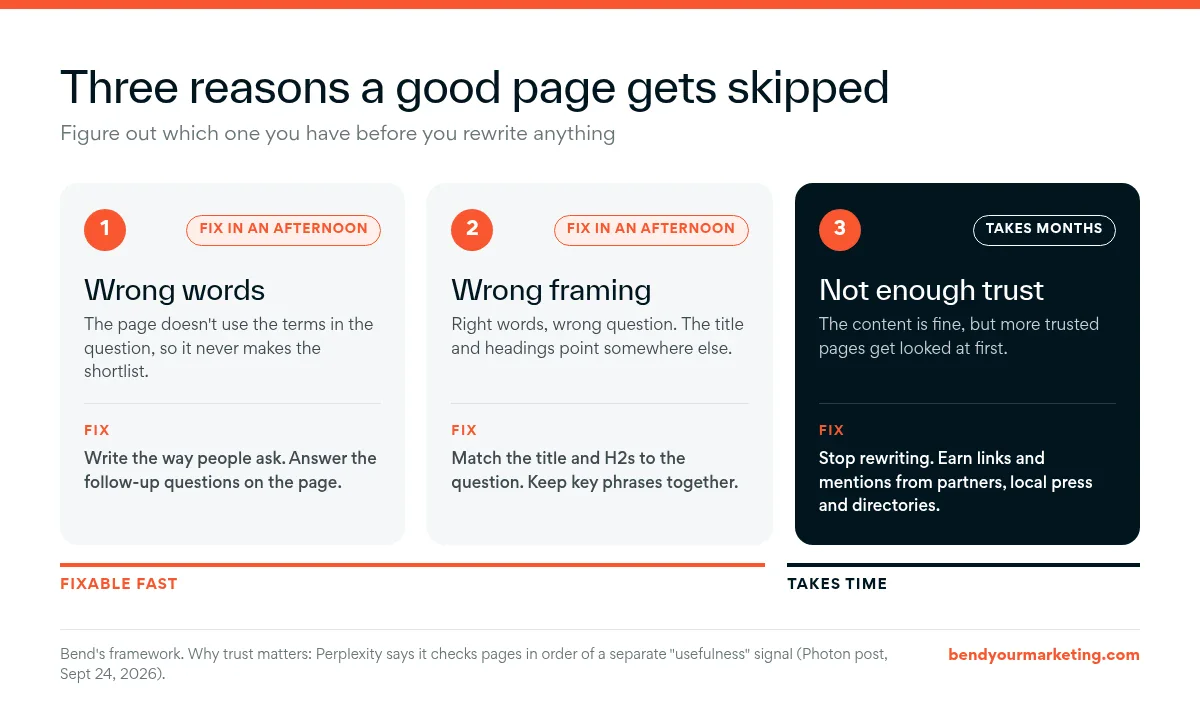
When a page doesn’t get cited, I’ve found it almost always comes down to one of three things:
- Wrong words. The page doesn’t use the terms in the question, so it never makes the shortlist.
- Wrong framing. The page uses the right words but answers a different question. Its title and headings point somewhere else.
- Not enough trust. The content is fine, but more trusted pages get looked at first.
The first two you can often fix in an afternoon. The third takes months. Knowing which one you have saves a lot of wasted rewriting.
A ministry example: “How do I become Catholic?”
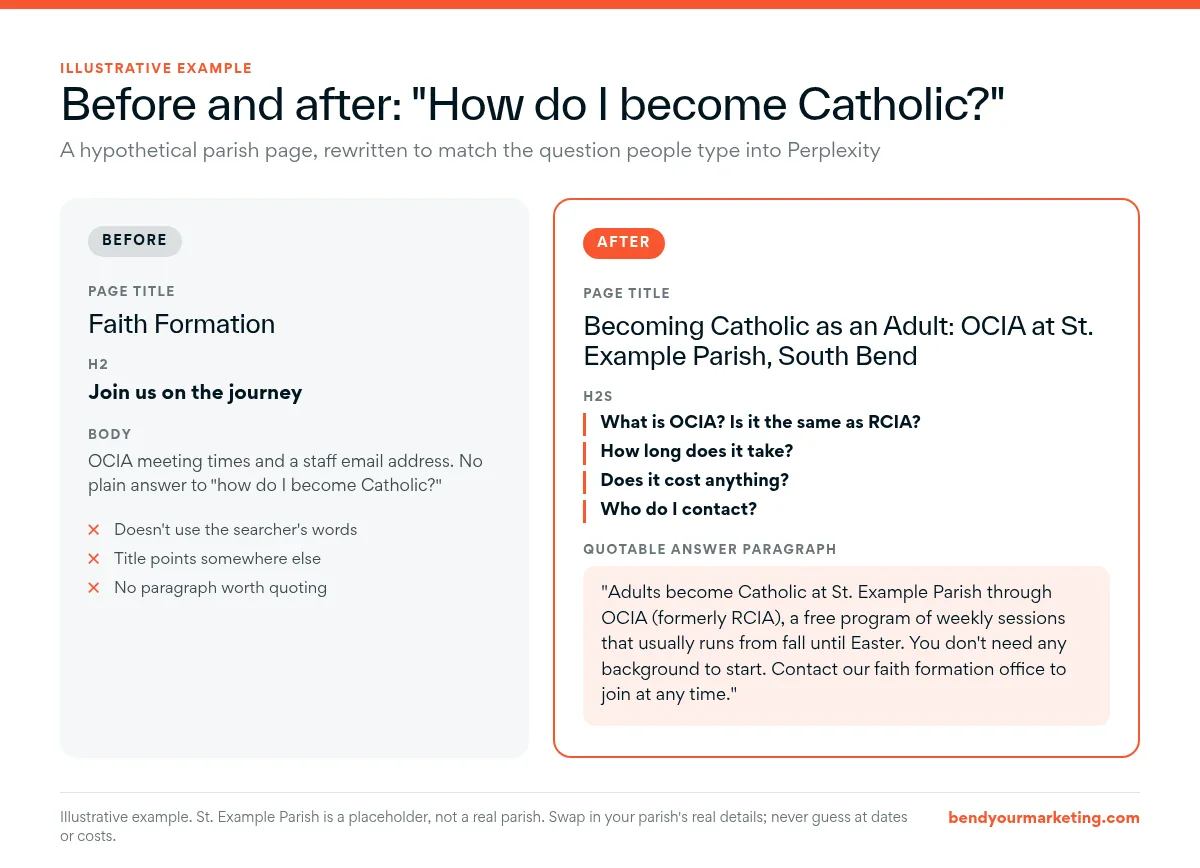
Picture a parish whose “Faith Formation” page lists OCIA meeting times and a staff email. Someone types into Perplexity: How do I become Catholic as an adult in South Bend?
Here’s how we’d work through it:
- Check who’s cited today. Ask Perplexity the question and write down every source it cites. Maybe it’s a diocesan page, a national Catholic site, and a parish across town.
- List the follow-up questions. What is OCIA? Is it the same as RCIA? How long does it take? When does it start? Does it cost anything? What if I was baptized in another church? Who do I contact?
- Close the gaps. Add a short, plain answer to each one. Use both “OCIA” and “RCIA,” since many people still search the old name.
- Fix the framing. Change the title to something like “Becoming Catholic as an Adult: OCIA at St. Example Parish, South Bend.” Use the questions as H2s.
- Write the quotable paragraph: “Adults become Catholic at St. Example Parish through OCIA (formerly RCIA), a free program of weekly sessions that usually runs from fall until Easter. You don’t need any background to start. Contact our faith formation office to join at any time.” (Swap in the parish’s real details. Never guess at dates or costs.)
- Build trust honestly. Make sure the diocese’s parish directory links to the page, and that the parish’s Google Business Profile, bulletin, and partner sites point to it too.
The same steps work for a Michiana business. A Granger HVAC company answering “how much does a furnace replacement cost in South Bend” needs the same things: the searcher’s words, a matching title, one straight answer, and a reputation other sites vouch for.
The 7-step checklist we use
This is how we approach it at Bend, using tools we already use for our clients’ Google SEO.
- Check who Perplexity cites today. We add an AI column to our Share of SERP audit. For each money keyword, we log which sites Perplexity, ChatGPT, and Google’s AI Overviews cite, next to who owns Google’s first page. Then we use AI to tear down those cited pages and ask a blunt question: why would a better page win here?
- Expand the question into sub-questions. In Semrush, we use the Keyword Magic Tool’s Questions filter and “People also ask” to list the follow-ups people really ask.
- Close coverage gaps naturally. We compare your page against the cited and ranking pages with Semrush’s Organic Research and Keyword Gap. Then we add the missing subtopics once or twice, in normal sentences. No stuffing, since Photon caps repeats anyway.
- Match titles and H2s to the question. We write the title and headings in the searcher’s words.
- Keep phrases intact. We use the exact phrasing people search (“OCIA classes,” “furnace replacement cost”).
- Write one quotable answer passage. It goes near the top and answers the question completely in two to four sentences.
- Re-check citations 1–2 weeks after publishing. Perplexity says fresh content can reach its index quickly, in minutes for some types of search. We re-run the same questions a week or two later and note what changed. To see whether AI tools send you visitors, track AI chatbot traffic in GA4.
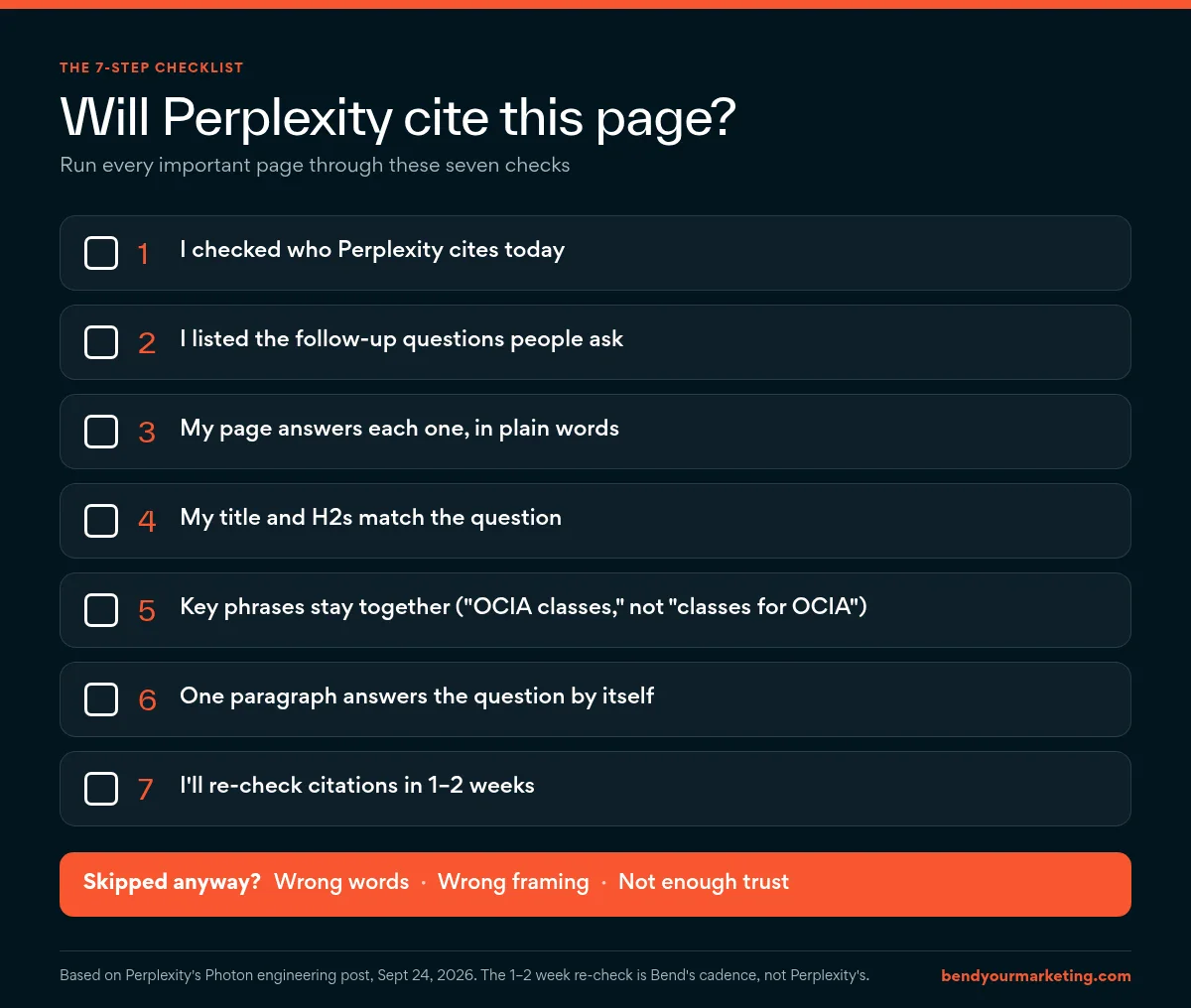
If steps 1–6 are done and you’re still not cited, it’s probably a trust problem. Stop rewriting and start earning links and mentions. Our LLM optimization audit guide and 7 fixes for AI search visibility cover that side.
What the Photon post doesn’t tell us
To be clear about the limits: Perplexity’s post is about infrastructure, not an SEO guide. It doesn’t explain:
- Chunking, meaning how pages are split into the “fragments” it mentions
- The second-stage ranker, which it says exists but doesn’t describe
- What goes into “usefulness,” the signal that decides which pages get checked first
It also doesn’t cover how questions get rewritten, or how the AI picks which source to cite. Anyone who claims to know exactly how those work is guessing, and that includes me. That’s why the checklist ends with checking your results, not assuming them.
Want help showing up in AI answers?
You don’t need a new “AI SEO” vendor. You need pages that answer real questions clearly, and a reputation other sites vouch for. That’s the same work that helps you rank on Google.
At Bend, that’s what our SEO services do for Catholic ministries, faith-based nonprofits, and established Michiana businesses. We work out which questions matter, check who AI engines cite today, fix the pages, and build the trust that keeps you there.
- SEO campaign ($1,500/mo): technical audit, keyword strategy, new and improved pages, links, and reporting.
- Marketing Starter Package ($499/mo): Google Business Profile posts and upkeep plus service-area pages, a simple way for a local organization to get clear, question-answering pages working for it.
See every option in our 2026 price guide, or start with a free website audit. Ministry? Here’s how we work with Catholic organizations.
Book a free strategy call → We’ll ask Perplexity your most important questions together and show you who it cites today.
Source: Perplexity Engineering, “Photon: Building a retrieval and ranking engine from scratch,” September 24, 2026. Quotes and figures above are as reported by Perplexity. Interpretations are mine.

