
 Book a Strategy Call

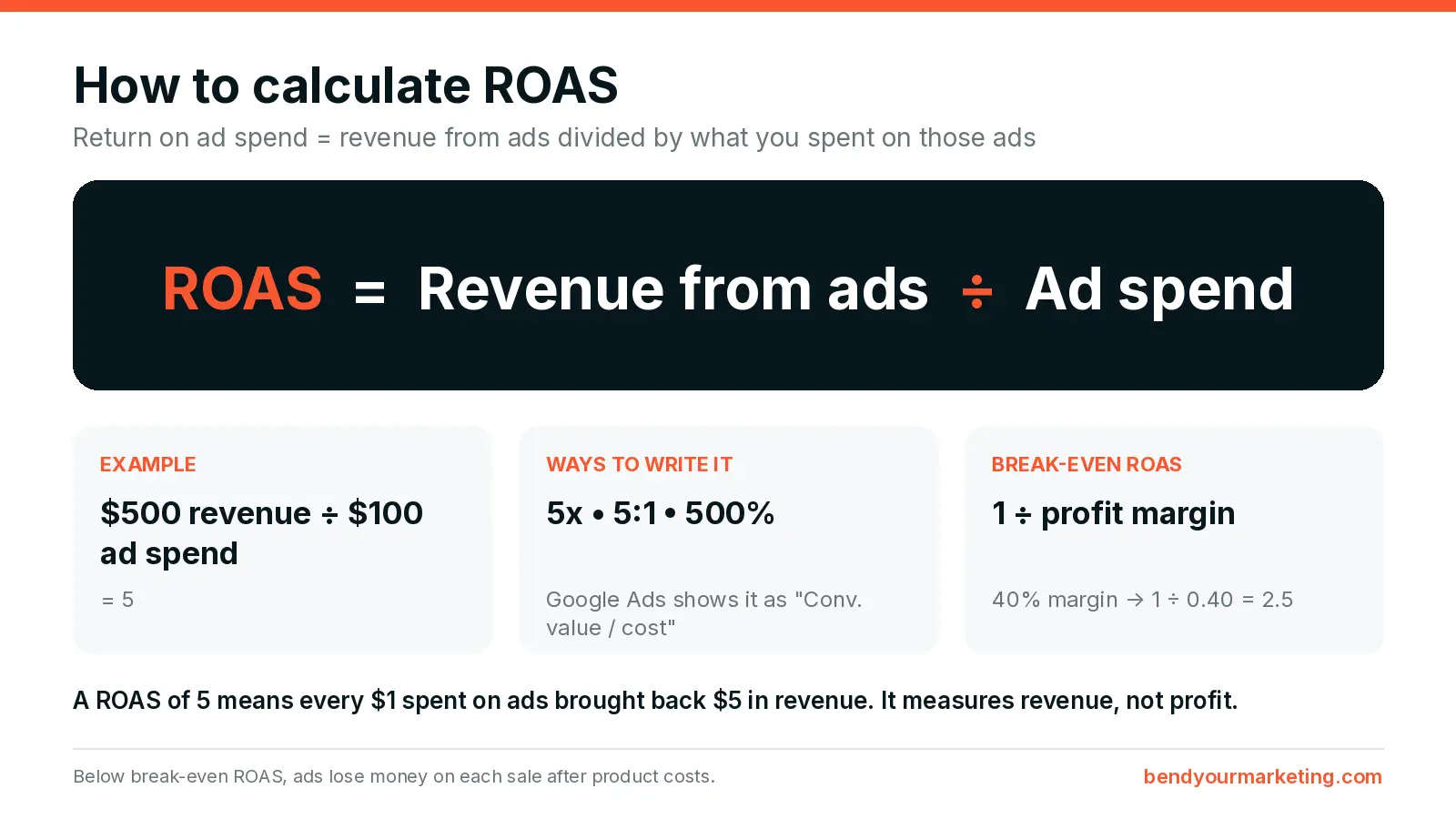
Quick answer: ROAS means return on ad spend: the revenue your ads bring in divided by what you spent on them. Spend $100, bring in $500, and your ROAS is 5 (also written 5x, 5:1 or 500%).
What does ROAS mean?
ROAS stands for “Return On Advertising Spend” and is a metric used to measure the efficiency of digital advertising spend. It shows how much revenue a company makes from each dollar spent on advertising. The higher the ROAS, the more effectively a company is using its ad budget. At Bend Marketing, we use ROAS to evaluate the efficiency of an advertising campaign and to determine whether the campaign is meeting the desired return on investment (ROI). It can also be used to compare the performance of different advertising campaigns and to make decisions about which campaigns to continue or optimize.
What is a good ROAS for Google Ads?
A good ROAS for Google Ads depends on a variety of factors, such as the industry, ad platform, and campaign goals.
Generally speaking, a ROAS goal of 2-4x is considered achievable and desirable for most businesses. However, some businesses may find that an even higher ROAS is more appropriate.
That 2–4x range is our rule of thumb at Bend. To find your own floor, work out your break-even ROAS: the point where ad revenue covers the cost of the product and the ads.
Break-even ROAS = 1 ÷ profit margin (use your margin after product and fulfillment costs)
| Your profit margin | Break-even ROAS |
| 20% | 5.0x |
| 30% | 3.3x |
| 40% | 2.5x |
| 50% | 2.0x |
| 60% | 1.7x |
If your margin is 40%, you need a ROAS above 2.5 just to break even. Anything above that is profit. That’s why a 3x ROAS can be a win for a high-margin product and a loss for a low-margin one.
A real example: For Runewood Rosary Co., a Catholic-owned maker of handmade rosaries, Performance Max returned $4.24 to $4.97 for every $1 spent every month from October 2025 through February 2026. Along with SEO, email and Shopify work, it helped the business grow from about $4K a month to consistently near $40K a month. Read the Runewood case study.
Ultimately it’s up to you to decide what is best for your business based on your industry and goals.
How to calculate ROAS
ROAS is calculated by dividing the revenue generated by the ad spend. For example, if a company spends $100 on an advertising campaign and generates $500 in revenue as a result, the ROAS would be 500/100 = 5. This means that for every $1 spent on advertising, the company generated $5 in revenue.
A few things to get right:
- Use revenue from ads only. Don’t count sales that came from email, organic search or walk-ins.
- Use the same time period for revenue and spend.
- Track conversion value. In Google Ads, ROAS appears as the “Conv. value / cost” column. It only works if your conversion tracking passes real revenue values (Google Ads Help: About Target ROAS bidding).
What is a bad ROAS?
A bad ROAS is any ROAS below your break-even point, because each sale then costs you more in product and ads than it brings in. A ROAS under 1 is always a loss on ad spend alone. The exception is when you’re deliberately paying to win first-time customers who come back and buy again; then judge the campaign on what those customers are worth over time.
ROAS vs. ROI: what’s the difference?
- ROAS = revenue ÷ ad spend. It measures how efficient your ads are.
- ROI = (profit − total cost) ÷ total cost. It measures whether the whole effort made money once product costs, fees and labor are counted.
Example: You spend $1,000 on ads and make $4,000 in sales, so ROAS is 4x. If the products cost $2,000 to make and ship and you paid $500 in management fees, your profit is $500 and your ROI is $500 ÷ $3,500, or about 14%. A healthy-looking ROAS can hide a thin ROI, so track both.
When ROAS isn’t the right metric
ROAS works best when each sale has a clear dollar value, like in ecommerce. For other goals:
- Lead generation (B2B, home services, healthcare): cost per lead or cost per qualified lead.
- Subscriptions and memberships: cost per new member compared with what a member is worth. For example, St. Paul Center for Biblical Theology had 1,046 membership purchases in January 2026 at $19.59 each, less than half its $46 target. See the St. Paul Center case study.
- Nonprofits and donations: cost per donor or per sign-up, plus the value of first gifts if you track them.
How Google Ads uses ROAS
If your tracking passes conversion values, you can use Target ROAS bidding: you tell Google the return you want, and it sets bids to hit it. Google’s example: if you want $5 in sales for every $1 you spend, your target ROAS is 500% (Google Ads Help). Set it too high and you’ll limit volume; set it too low and you may overspend on low-value sales.
How to improve your ROAS
- Fix your tracking first. Bad data leads to bad bidding.
- Cut wasted spend. Review search terms, add negative keywords and pause what doesn’t convert. Our guide to paid media keyword research can help.
- Improve the landing page. A faster page with a clearer offer converts more of the clicks you already pay for.
- Feed better product data. For Shopping and Performance Max, strong titles, images and prices make a real difference.
- Raise order value. Bundles, add-ons and free-shipping thresholds raise revenue per sale.
- Scale carefully. See how to scale your paid campaigns.
If your ROAS has slipped and you’re not sure why, start with why your ads aren’t working.
Want a second set of eyes on your ROAS?
Our paid ads audit ($500) reviews your tracking, campaigns and targeting and gives you a clear list of fixes. See our rate card or book a strategy call. Running ads for a nonprofit? Ask about our free Google Ad Grant check.

